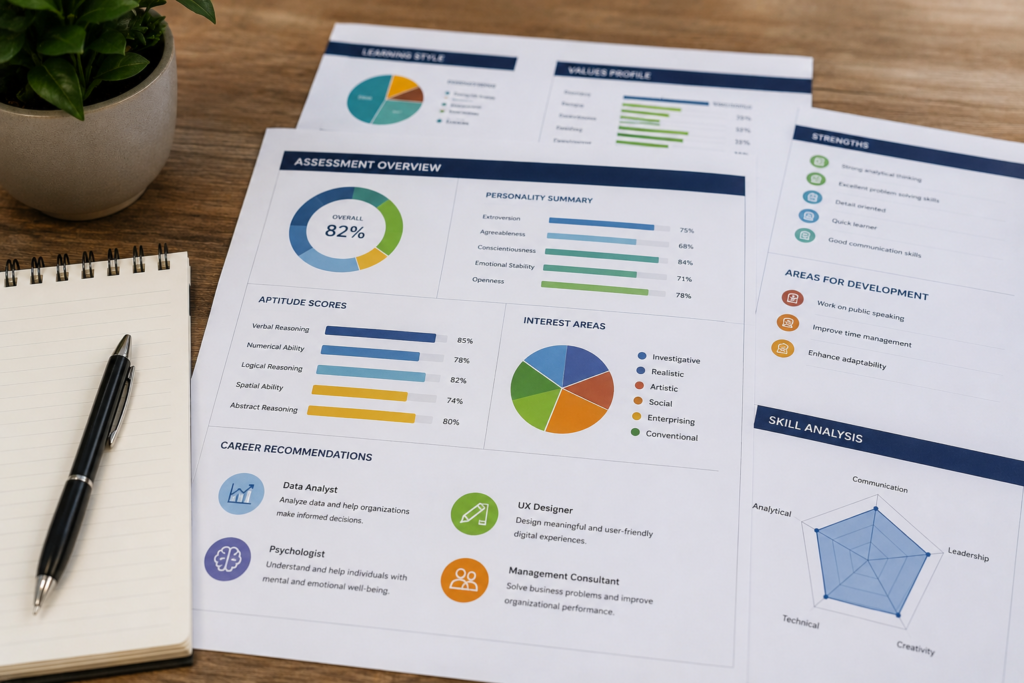
Every student is unique, with different strengths, interests, learning styles, and personal qualities. Choosing the right educational path or future career becomes much easier when students understand these individual characteristics. While academic performance provides valuable information, it does not always reflect a student’s complete potential. Personality assessment for students helps identify behavioral traits, communication styles, emotional preferences, and personal characteristics that influence learning, decision-making, and career success.
Many students experience uncertainty when selecting subjects, college courses, or career options because they are unsure about their natural abilities and personality traits. Some students perform well in leadership roles, while others excel in creative thinking, analytical problem-solving, teamwork, or independent work. Understanding these differences allows students to make better educational and career decisions. Personality assessment for students provides structured insights that help students recognize their strengths and identify environments where they are most likely to succeed.
Parents and educators often encourage students to choose careers based on academic performance or popular career trends. However, long-term career satisfaction depends on much more than grades alone. Personality traits influence communication, work preferences, leadership style, adaptability, motivation, and relationships with others. Professional personality assessments help students understand these characteristics and align them with suitable academic and professional opportunities.
Unlike informal personality quizzes available online, scientifically developed personality assessments use standardized methods to evaluate different behavioral patterns and personal preferences. Qualified career counselors interpret these assessment results alongside aptitude, interests, academic performance, and career aspirations to provide personalized guidance. This comprehensive approach allows students to make informed decisions rather than relying on assumptions or external pressure.
Developing self-awareness during school years provides long-term advantages. Students who understand their personalities often become more confident, motivated, and prepared to face educational and career challenges. Personality assessment for students encourages personal growth by helping students appreciate their strengths while identifying areas where further development may be beneficial.
This comprehensive guide explains Personality assessment for students, explores how personality assessments work, discusses their importance in career planning, and highlights why understanding personality is an essential step toward making informed educational and professional decisions.
Table of Contents
What Is Personality Assessment for Students?
Personality assessment for students is a structured evaluation process that helps identify a student’s behavioral traits, communication style, emotional preferences, strengths, and personal characteristics.
Rather than measuring intelligence or academic knowledge, personality assessments focus on understanding how students naturally think, interact, learn, and respond to different situations.
These insights help students make better educational and career choices.
Why Personality Assessment Is Important
Every student learns differently and has unique personal qualities.
Understanding these qualities supports better academic planning and long-term career development.
Personality assessment for students helps:
- Increase self-awareness
- Improve career planning
- Identify personal strengths
- Understand communication style
- Support educational decisions
- Build confidence
Greater self-understanding leads to more informed decision-making.
How Personality Assessments Work
Professional personality assessments use scientifically developed questionnaires designed to evaluate behavioral patterns and individual preferences.
Students answer questions related to:
- Decision-making
- Communication
- Learning style
- Emotional responses
- Leadership preferences
- Social interaction
Qualified career counselors then interpret the assessment results and explain how different personality characteristics relate to academic environments and career opportunities.
Key Personality Traits Evaluated
Different personality assessments evaluate different characteristics.
Some of the most commonly measured traits include:
Communication Style
Communication plays an important role in academic success and future careers.
Assessments evaluate whether students naturally prefer:
- Individual conversations
- Group discussions
- Written communication
- Public speaking
Understanding communication preferences improves both learning and career planning.
Leadership Qualities
Some students naturally enjoy leading teams, organizing activities, and making decisions.
Others prefer supporting roles where collaboration is their primary strength.
Recognizing leadership tendencies helps students explore suitable career opportunities.
Emotional Awareness
Emotional awareness influences how students manage stress, relationships, and decision-making.
Personality assessment for students helps identify emotional strengths that contribute to healthier personal and professional relationships.
Learning Preferences
Every student processes information differently.
Some students learn best through:
- Visual materials
- Practical activities
- Reading
- Discussion
- Independent study
Understanding learning preferences helps improve academic performance.
Problem-Solving Style
Students approach challenges in different ways.
Some rely on logical analysis, while others prefer creative thinking or collaborative solutions.
Recognizing these preferences supports better educational planning.
Why Students Should Take a Personality Assessment Early

Early self-awareness provides students with valuable guidance before making important educational decisions.
Taking Personality assessment for students during school helps students:
- Choose suitable subjects
- Explore appropriate career paths
- Build confidence
- Improve decision-making
- Understand personal strengths
- Develop future career goals
Early guidance reduces confusion during career planning.
The Role of Self-Awareness in Student Success
One of the greatest benefits of Personality assessment for students is developing self-awareness. Students who understand their strengths, communication styles, emotional preferences, and personal values often make more confident academic and career decisions. Self-awareness also improves relationships with teachers, classmates, and family members by encouraging better communication and emotional understanding. As students become more aware of their unique qualities, they gain the confidence to pursue educational opportunities that match their personality, interests, and long-term aspirations while continuing to grow both personally and professionally.
12 Benefits of Personality Assessment for Students
Understanding personal strengths and behavioral preferences helps students make informed educational and career decisions. Personality assessment for students provides valuable insights that support self-awareness, confidence, and long-term personal development. Instead of relying only on academic performance, these assessments help students recognize how their personality influences learning, communication, leadership, and future career success.
1. Improves Self-Awareness
One of the greatest benefits of Personality assessment for students is helping students understand themselves better.
Students gain valuable insights into their:
- Strengths
- Behavioral patterns
- Communication style
- Personal preferences
- Emotional responses
Greater self-awareness supports better decision-making.
2. Supports Better Career Planning
Career satisfaction often depends on choosing a profession that matches both abilities and personality.
Personality assessments help students explore careers that align with their natural characteristics and work preferences.
3. Builds Self-Confidence
Students who understand their strengths often become more confident while making educational and career decisions.
Confidence encourages greater motivation and a positive attitude toward future opportunities.
4. Helps Choose Suitable Subjects
Selecting academic subjects becomes easier when students understand their interests, learning preferences, and personality traits.
Personality assessment for students provides valuable guidance before important educational decisions.
5. Improves Communication Skills
Understanding personal communication styles helps students interact more effectively with teachers, classmates, family members, and future colleagues.
Better communication contributes to stronger personal and professional relationships.
6. Encourages Personal Growth
Personality assessments identify both strengths and areas that may benefit from further development.
Students can improve leadership, teamwork, communication, and emotional awareness through continuous learning.
7. Supports Better Decision-Making
Understanding personal values and behavioral tendencies allows students to make more informed educational and career choices.
Thoughtful decision-making reduces uncertainty about the future.
8. Identifies Leadership Potential
Some students naturally enjoy organizing activities, motivating others, and making decisions.
Personality assessments help recognize these leadership qualities early.
9. Improves Teamwork
Learning how individuals interact with others encourages better collaboration during school projects and future professional environments.
Healthy teamwork is an essential life skill.
10. Helps Manage Stress
Understanding emotional responses helps students develop healthier ways to manage academic pressure, examinations, and daily challenges.
Greater emotional awareness supports overall well-being.
11. Encourages Lifelong Learning
Students become more open to learning when they understand their preferred learning styles and personal development opportunities.
Continuous improvement supports long-term success.
12. Prepares Students for Future Success
Personality assessment for students helps students build confidence, strengthen communication, improve relationships, and prepare for future academic and professional responsibilities.
Early self-awareness creates a strong foundation for lifelong growth.
Factors Evaluated During Personality Assessments

Professional Personality assessment for students evaluates several important behavioral characteristics that influence education and career planning.
Communication Preferences
Assessments evaluate how students naturally communicate with others.
Some individuals prefer:
- Group discussions
- Individual conversations
- Written communication
- Public speaking
Understanding communication preferences improves both academic and social interactions.
Decision-Making Style
Students approach decisions differently.
Some rely on careful analysis, while others make decisions based on creativity, intuition, or practical experience.
Recognizing these tendencies supports better career planning.
Emotional Intelligence
Personality assessments help students understand:
- Emotional awareness
- Self-control
- Empathy
- Relationship management
These qualities contribute to healthy personal and professional relationships.
Adaptability
Students respond differently to change and new situations.
Understanding adaptability helps students prepare for academic transitions and future workplace environments.
Work Preferences
Some students enjoy independent work, while others perform better in collaborative environments.
Recognizing these preferences supports informed educational and career choices.
The Role of Career Counselors
Assessment results become significantly more valuable when interpreted by experienced career counselors.
Professional counselors help students:
- Understand personality reports
- Explore suitable career options
- Identify strengths
- Set realistic educational goals
- Develop personalized career plans
Instead of simply explaining scores, counselors connect personality characteristics with practical academic and career opportunities.
Common Misconceptions About Personality Assessments
Many students and parents misunderstand the purpose of Personality assessment for students.
Myth 1: Personality Never Changes
Fact: Personality develops over time through learning, experiences, and personal growth. Assessments reflect current behavioral tendencies rather than permanent labels.
Myth 2: Personality Assessments Decide Your Career
Fact: Personality assessments provide guidance, not fixed career decisions.
Career planning also considers aptitude, interests, academic performance, values, and goals.
Myth 3: There Is One Perfect Personality Type
Fact: Every personality type has unique strengths.
Different careers require different combinations of personal qualities.
Myth 4: Personality Assessments Measure Intelligence
Fact: Personality assessments evaluate behavioral traits, communication styles, emotional preferences, and work habits rather than intelligence or academic ability.
Long-Term Benefits of Personality Assessment
The insights gained through Personality assessment for students continue supporting students throughout their educational and professional journey.
Long-term benefits include:
- Better self-awareness
- Improved confidence
- Stronger communication
- Better career decisions
- Healthier relationships
- Increased adaptability
- Continuous personal growth
- Greater career satisfaction
By participating in Personality assessment for students, students gain a deeper understanding of their unique characteristics, communication styles, and personal strengths. Combined with professional career counseling, these insights help students make informed academic decisions, choose careers that align with their personalities, and develop the confidence and skills needed for long-term personal and professional success.
Tips to Get the Most Accurate Personality Assessment Results
The value of Personality assessment for students depends on answering the assessment honestly and thoughtfully. Students should focus on describing their natural behavior rather than selecting answers they believe are expected. Genuine responses help create an accurate personality profile that supports better educational and career planning.
Answer Honestly
Students should answer every question based on their actual behavior and preferences.
Avoid trying to choose the “best” answer, as honest responses produce more meaningful assessment results.
Avoid Overthinking Questions
Personality assessments are designed to understand natural behavioral patterns.
Choosing the first response that genuinely reflects your personality often provides the most accurate outcome.
Stay Relaxed During the Assessment
Feeling calm helps students focus on each question without unnecessary pressure.
There are no right or wrong answers in Personality assessment for students, making it important to answer naturally.
Complete the Assessment Independently
Students should avoid discussing questions with others while completing the assessment.
Independent responses ensure the report accurately reflects individual personality traits.
Review the Results With a Career Counselor
Professional interpretation is an important part of Personality assessment for students.
Career counselors explain personality reports, answer questions, identify strengths, and suggest educational and career pathways that match the student’s overall profile.
How to Use Personality Assessment Results Effectively
Receiving a personality assessment report is only the first step. Students should use the results to make informed decisions about their education, career planning, and personal development.
The assessment can help students:
- Understand personal strengths
- Improve communication skills
- Explore suitable career options
- Choose appropriate academic subjects
- Build leadership qualities
- Develop emotional intelligence
- Set realistic educational goals
Using these insights consistently helps students grow with greater confidence.
Frequently Asked Questions
What is Personality assessment for students?
Personality assessment for students is a structured evaluation that helps identify behavioral traits, communication styles, emotional preferences, and personal strengths to support educational and career planning.
Who should take a personality assessment?
School students, college students, and individuals preparing for future career decisions can all benefit from understanding their personality characteristics.
Is a personality assessment the same as an aptitude test?
No.
Personality assessments evaluate behavioral traits and preferences, while aptitude tests measure natural abilities and problem-solving skills.
Both assessments complement each other during career planning.
Can personality assessments predict career success?
No.
Personality assessment for students provides guidance by helping students understand themselves better, but career success also depends on skills, interests, education, motivation, and continuous learning.
Why should students discuss the report with a career counselor?
Career counselors help students interpret assessment results correctly and connect personality traits with suitable educational pathways and career opportunities.
Can personality change over time?
Yes.
Personality develops through life experiences, education, personal growth, and changing responsibilities.
Periodic self-assessment can help students understand these changes.
Final Thoughts
Understanding personality is one of the most valuable steps students can take before making important educational and career decisions. Academic performance alone cannot fully describe an individual’s strengths, communication style, learning preferences, or emotional characteristics. Personality assessment for students provides deeper self-awareness that helps students make confident decisions, improve relationships, and prepare for long-term personal and professional success.
Conclusion
Choosing the right educational pathway and future career begins with understanding yourself. Personality assessment for students provides valuable insights into behavioral traits, communication styles, emotional preferences, leadership qualities, and learning patterns that influence academic achievement and career satisfaction. Rather than placing students into fixed categories, these assessments encourage self-awareness and personal growth while helping them recognize both their strengths and opportunities for improvement.
When combined with professional career counseling, personality assessments become even more effective. Career counselors help students interpret their reports, explore suitable educational opportunities, and create personalized development plans that align with their interests, abilities, and long-term aspirations. This comprehensive approach supports better decision-making and reduces uncertainty during important stages of academic planning.
Ultimately, Personality assessment for students empowers young learners to make informed choices, build confidence, strengthen communication skills, and prepare for a successful future. By understanding their unique personalities and continuously developing their strengths, students can pursue educational and career paths that lead to greater satisfaction, personal growth, and lifelong success.
Contact Information

Amitabh Psychology
S-30, Kris Korner Commercial Plaza, Anand Nagar, Thane West, Thane, Maharashtra 400615
Phone: +91 9136092759
App: https://clpbarney.page.link/q179
YouTube: https://www.youtube.com/amitabhpsychology
Facebook: https://www.facebook.com/Amitabh-Psychology-104335605524034
Facebook Group: Amitabh Psychology
LinkedIn: https://www.linkedin.com/in/amitabh.s.karmakar
Instagram: https://www.instagram.com/amitabhpsychology/
Take the first step toward a brighter future today with expert Career Counselling in Thane from Dr. Amitabh.