
Choosing a career is one of the most important decisions a student will ever make. The right career choice can lead to professional success, financial stability, job satisfaction, and personal fulfillment. On the other hand, poor career decisions can result in frustration, stress, lack of motivation, and years of uncertainty.
Unfortunately, many students make career choices without proper guidance, self-awareness, or understanding of future opportunities. In today’s rapidly changing world, where industries are evolving and new job roles are emerging every year, career planning has become more important than ever before.
Understanding the career planning mistakes students should avoid can help students make informed decisions and build a successful future. Career planning is not just about selecting a course after school or college. It is a structured process that involves identifying strengths, interests, values, personality traits, skills, and future aspirations.
Many students choose careers based on social pressure, parental expectations, or temporary trends. Others delay planning until graduation, which limits their options and preparedness. By recognizing the common career planning mistakes students should avoid, students can develop a clear roadmap and confidently move toward their goals.
This comprehensive guide explores the most common mistakes students make while planning their careers and provides practical solutions to avoid them.
Table of Contents
What Is Career Planning?
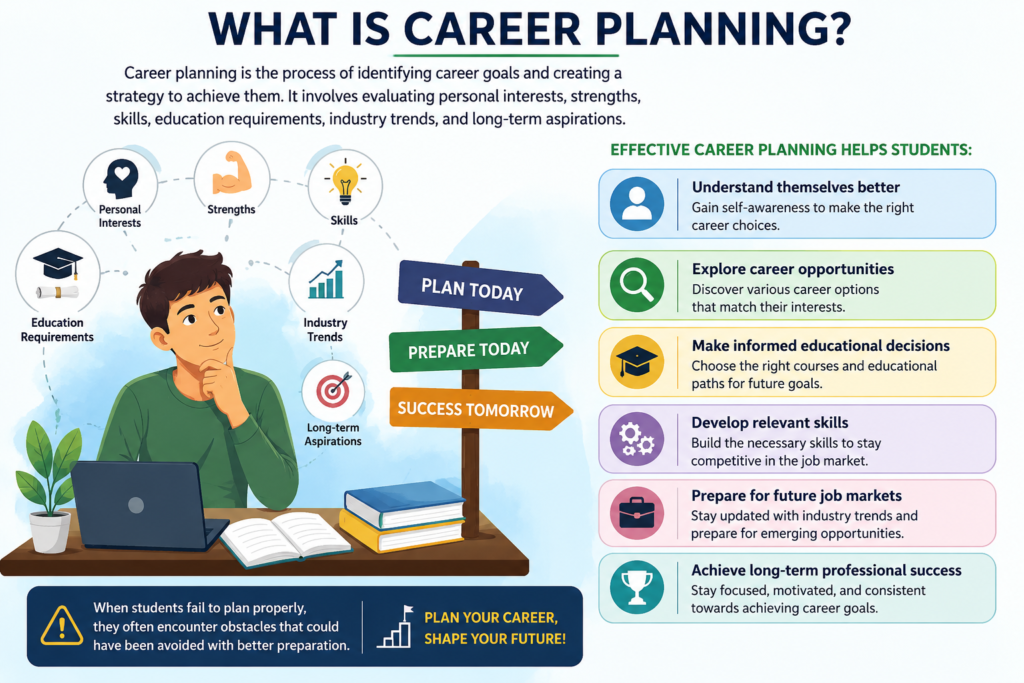
Career Planning Mistakes can significantly impact a student’s future if they are not addressed at the right time. Career planning is the process of identifying career goals and creating a structured strategy to achieve them. It involves understanding personal interests, strengths, skills, values, educational requirements, industry trends, and long-term aspirations. However, many students unknowingly make Career Planning Mistakes by choosing careers based on peer pressure, family expectations, or limited information.
Effective career planning helps students make informed decisions rather than relying on assumptions. It allows them to explore various career opportunities, identify suitable educational pathways, and develop the skills needed for long-term success. One of the most common Career Planning Mistakes is failing to assess personal strengths and interests before selecting a career path. Another major Career Planning Mistake is ignoring changing industry trends and future job market demands.
A well-planned career path enables students to gain clarity, confidence, and direction. It helps them set realistic goals, create actionable plans, and prepare for academic and professional challenges. By understanding potential opportunities and challenges, students can avoid unnecessary confusion and setbacks. Recognizing and avoiding Career Planning Mistakes early can lead to better career satisfaction, improved performance, and greater success in the future. Learning from common Career Planning Mistakes ensures students make smarter and more confident career decisions.
Understanding the Career Planning Mistakes Students Should Avoid is equally important during this process. Many students make decisions without proper research or self-assessment, which can lead to confusion and dissatisfaction later. By learning about the Career Planning Mistakes Students Should Avoid, students can make smarter choices and reduce the risk of selecting an unsuitable career path.
Career planning is not a one-time activity but an ongoing process that evolves with changing interests, skills, and opportunities. Being aware of the Career Planning Mistakes Students Should Avoid can help students build a successful, fulfilling, and future-ready career.
Why Career Planning Is Important for Students
Before discussing the career planning mistakes students should avoid, it is important to understand why career planning matters.
Career planning helps students:
Gain Clarity
Students gain a better understanding of what they want from their future.
Improve Decision-Making
Career planning provides a framework for making informed choices regarding education and employment.
Save Time and Resources
Proper planning reduces the risk of choosing unsuitable courses or changing career paths repeatedly.
Increase Confidence
Students who understand their goals feel more confident about their future.
Enhance Employability
Career-focused students are more likely to develop relevant skills and gain valuable experiences.
1. Choosing a Career Based on Peer Pressure

One of the most common career planning mistakes students should avoid is selecting a career simply because their friends are pursuing it.
Students often choose engineering, medicine, business, or government jobs because their peer group is doing the same. While it may feel comfortable to follow friends, career decisions should never be based on someone else’s journey.
Every individual has unique interests, strengths, and goals. A career that suits one person may not be suitable for another.
How to Avoid It
- Focus on your own interests.
- Conduct self-assessment exercises.
- Explore multiple career options.
- Seek professional guidance.
2. Following Parental Expectations Without Understanding Personal Interests
Parents often want their children to have stable and successful careers. However, many students choose professions solely to satisfy family expectations.
This can create long-term dissatisfaction if the chosen field does not align with personal interests.
For example, a student passionate about design may struggle in medicine despite having the academic ability to succeed.
Among the major career planning mistakes students should avoid, ignoring personal aspirations can have lasting consequences.
Solution
- Have open discussions with parents.
- Share your interests and goals honestly.
- Explore career options together.
- Seek career counselling when necessary.
3. Ignoring Self-Assessment
Successful career planning begins with self-awareness.
Students who do not understand their strengths, weaknesses, values, and interests often make poor career choices.
Before selecting a career path, students should evaluate:
- Personality traits
- Skills
- Interests
- Learning preferences
- Motivations
Ignoring self-assessment is one of the critical career planning mistakes students should avoid because it increases the risk of entering unsuitable professions.
4. Not Exploring Enough Career Options
Many students know only a limited number of professions.
Traditionally, students often consider:
- Engineering
- Medicine
- Law
- Business
- Government jobs
However, today’s world offers hundreds of exciting career opportunities.
Examples include:
- Artificial Intelligence
- Data Science
- Cybersecurity
- Digital Marketing
- Game Development
- UX/UI Design
- Psychology
- Content Strategy
- Environmental Science
Students should research broadly before making decisions.
5. Choosing a Career Solely for Money
Financial stability is important, but it should not be the only factor in career selection.
A high-paying job that does not match your interests may lead to burnout and dissatisfaction.
One of the major career planning mistakes students should avoid is assuming that salary alone guarantees happiness.
Consider Other Factors
- Passion
- Work-life balance
- Career growth
- Industry demand
- Personal satisfaction
- Learning opportunities
6. Lack of Career Research
Many students make decisions without understanding the realities of a profession.
They may know the title but not the responsibilities, qualifications, challenges, or growth opportunities.
Proper research should include:
- Job roles
- Required education
- Salary expectations
- Future demand
- Industry trends
Failing to conduct research is one of the important career planning mistakes students should avoid.
7. Avoiding Career Counselling
Career counselling provides valuable guidance during decision-making.
Professional career counsellors use scientific assessments to identify suitable career options.
Students who avoid expert guidance may miss opportunities that align with their strengths.
Career counselling helps students:
- Understand themselves
- Explore options
- Clarify doubts
- Build confidence
Ignoring professional support remains one of the significant career planning mistakes students should avoid.
8. Not Setting Clear Career Goals
Many students say they want to be successful but cannot define what success means.
Without clear goals, students often lose direction and motivation.
Goals should be:
- Specific
- Measurable
- Achievable
- Relevant
- Time-bound
Students who fail to set goals often struggle to create effective action plans.
9. Ignoring Future Industry Trends
The job market is evolving rapidly due to technology and globalization.
Careers that were popular ten years ago may not offer the same opportunities today.
Students must understand:
- Automation trends
- Emerging industries
- Technological advancements
- Future workforce demands
Ignoring these changes is among the career planning mistakes students should avoid because it can lead to outdated career choices.
10. Neglecting Skill Development
Degrees alone are no longer sufficient.
Employers seek candidates with practical and transferable skills.
Important skills include:
- Communication
- Leadership
- Problem-solving
- Teamwork
- Digital literacy
- Critical thinking
Students who focus only on academic performance may struggle during recruitment.
Neglecting skills is one of the most damaging career planning mistakes students should avoid.
11. Not Gaining Practical Experience
Practical experience helps students understand workplace realities.
Internships, volunteer work, projects, and part-time jobs provide valuable exposure.
Benefits include:
- Skill development
- Professional networking
- Industry understanding
- Resume enhancement
Students who graduate without practical experience often face challenges in the job market.
12. Comparing Yourself to Others
Social media has increased the tendency to compare achievements.
Students frequently compare:
- Grades
- Colleges
- Career choices
- Internships
- Salaries
However, comparison can create unnecessary stress and poor decisions.
One of the major career planning mistakes students should avoid is choosing a path simply because someone else appears successful in it.
13. Ignoring Soft Skills
Soft skills are essential for long-term career success.
Many students focus exclusively on technical expertise while overlooking interpersonal abilities.
Important soft skills include:
- Communication
- Emotional intelligence
- Adaptability
- Collaboration
- Leadership
- Conflict resolution
Strong soft skills often differentiate successful professionals from average performers.
14. Failing to Build a Professional Network
Networking plays a crucial role in career growth.
Students who build professional relationships gain access to:
- Mentorship
- Internships
- Job opportunities
- Industry insights
Networking can begin through:
- Professional events
- Workshops
- Alumni communities
Ignoring networking opportunities is one of the lesser-known career planning mistakes students should avoid.
15. Waiting Too Long to Start Career Planning
Many students postpone career planning until the final year of school or college.
This limits the time available for:
- Skill development
- Career exploration
- Internships
- Networking
Starting early allows students to make informed decisions and prepare effectively for future opportunities.
Delaying career planning is among the most common career planning mistakes students should avoid.
Real-Life Consequences of Poor Career Planning
Understanding the consequences can motivate students to plan more effectively.
Frequent Career Changes
Students may repeatedly switch courses or professions.
Financial Loss
Changing educational paths often requires additional investment.
Reduced Confidence
Poor decisions can create self-doubt and anxiety.
Career Dissatisfaction
Working in an unsuitable profession affects motivation and productivity.
Delayed Success
Lack of planning often slows career progression.
The Role of Parents in Career Planning
Parents significantly influence career decisions.
Supportive parents can help students:
- Explore options
- Build confidence
- Access resources
- Seek professional guidance
However, parents should avoid imposing personal ambitions on their children.
Instead, they should encourage informed decision-making.
How Career Counselling Helps Students Avoid Career Mistakes
Career counselling offers structured guidance that helps students avoid many common pitfalls.
Benefits include:
Self-Discovery
Students gain insights into their interests and strengths.
Career Clarity
Professional assessments identify suitable career options.
Better Decision-Making
Students make choices based on evidence rather than assumptions.
Reduced Stress
Counselling reduces confusion and uncertainty.
Long-Term Planning
Students develop realistic and achievable career roadmaps.
This is why career experts frequently emphasize understanding the career planning mistakes students should avoid before making important educational decisions.
Importance of Psychometric Assessments in Career Planning
Psychometric assessments provide scientific insights into a student’s personality, interests, aptitude, strengths, and career preferences. They help identify suitable career paths based on individual potential rather than assumptions. Understanding the Career Planning Mistakes Students Should Avoid becomes easier through these assessments, enabling students to make informed and confident career decisions for long-term success.
- Personality
- Aptitude
- Interests
- Behavioral patterns
These assessments help students understand which careers are most compatible with their strengths.
Benefits include:
- Objective evaluation
- Better career matching
- Increased confidence
- Improved decision-making
Psychometric assessments are becoming an essential part of modern career planning.
Career Planning Checklist for Students
Utilizing a well-structured checklist is the smartest way to avoid common career Career Planning Mistakes that many students make. From choosing the wrong stream to ignoring skill development and market trends, these errors can delay your success. Stay proactive, seek guidance early, and build a clear, realistic roadmap for a bright and fulfilling professional future.
Self-Assessment
✔ Identify strengths and weaknesses
Career Exploration
✔ Research multiple professions
Goal Setting
✔ Define short-term and long-term goals
Skill Development
✔ Build technical and soft skills
Practical Experience
✔ Complete internships and projects
Networking
✔ Connect with industry professionals
Career Counselling
✔ Seek expert guidance when needed
Continuous Learning
✔ Stay updated with industry trends
Frequently Asked Questions
When should students start career planning?
Ideally, students should begin career exploration during secondary school. Early planning provides more opportunities for growth and preparation.
Why do students make poor career decisions?
Lack of awareness, peer pressure, family expectations, and insufficient guidance often contribute to poor decisions.
Can career counselling help confused students?
Yes. Career counselling provides clarity, direction, and scientific assessments that support informed decision-making.
How important are internships?
Internships provide practical experience, improve employability, and help students understand workplace expectations.
Are psychometric tests reliable?
When administered by qualified professionals, psychometric assessments can provide valuable insights into career suitability.
Conclusion
Career planning is a journey that requires self-awareness, research, preparation, and continuous learning. Unfortunately, many students make avoidable mistakes that negatively affect their future opportunities. Understanding the career planning mistakes students should avoid can help students make informed choices and build successful careers.
Whether it is following peer pressure, ignoring personal strengths, avoiding career counselling, neglecting skill development, or delaying career planning, each mistake has the potential to create long-term challenges. However, with the right guidance, students can avoid these pitfalls and confidently pursue careers that align with their interests, abilities, and goals.
The most successful professionals are not always the smartest or most talented individuals. They are often the people who make thoughtful decisions, continuously learn, and adapt to changing circumstances. By understanding and avoiding the career planning mistakes students should avoid, students can create a clear roadmap toward a fulfilling, rewarding, and future-ready career.
Contact Amitabh Psychology

If you are looking for expert Career counselling for students in Mumbai, professional guidance can help you make informed decisions about your future.
Amitabh Psychology
S-30, Kris Korner Commercial Plaza, Anand Nagar, Thane West, Thane, Maharashtra 400615
Phone: +91 9136092759
App: https://clpbarney.page.link/q179
YouTube: https://www.youtube.com/amitabhpsychology
Facebook: https://www.facebook.com/Amitabh-Psychology-104335605524034
Facebook Group: Amitabh Psychology
LinkedIn: https://www.linkedin.com/in/amitabh.s.karmakar
Instagram: https://www.instagram.com/amitabhpsychology/
Take the first step toward a brighter future today with expert Career Counselling in Thane from Dr. Amitabh.